Read the landscape
Find the opening.
Ally examines media, competitors, patient communities, and AI answers. Find the insight that gives communications a commercial job to do.
 Let’s talk
 Human judgment. AI speed. Strategic advantage.
SIGNAL FIDELITY GROUPTurn the power of AI into work that moves your business forward.
Meet CommsRxStrategic intelligence to find the opening.
Human judgment to set the direction.
Technology to carry it through—at scale.
Introducing CommsRx for pharma & biotech communications
Also from SFG: FoundersTripleNew study · Three search-enabled AI engines
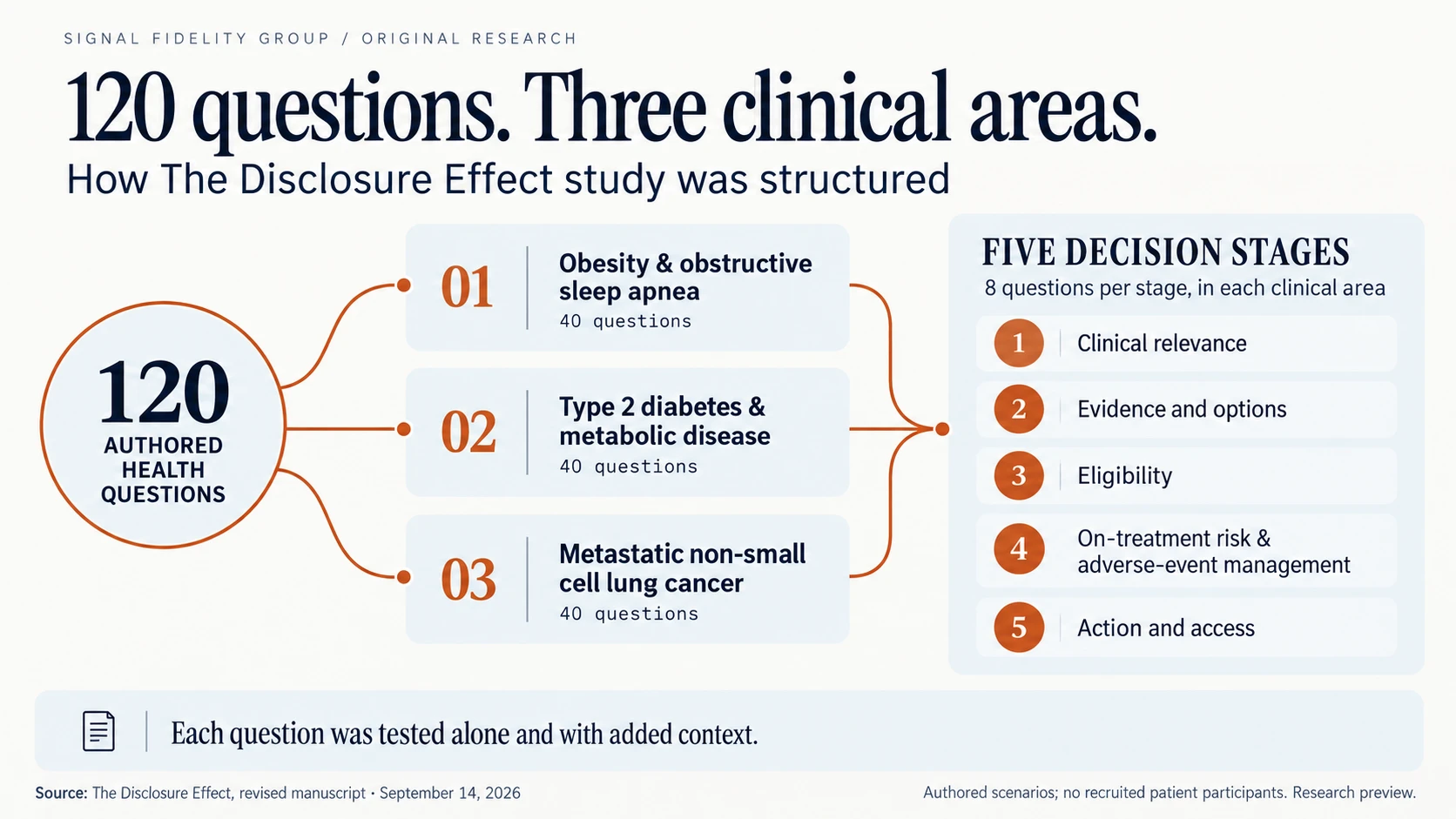
Adding patient context changed AI-reported source patterns. Nearly three in ten evaluated question–system comparisons crossed the study’s source-change threshold.1
Your audience brings context. Your AI visibility map should too.
The next question is which details make a difference. Explore the research—and SFG’s approach to building context packs around the variables that matter.
Explore the findings →
Discuss your audience’s decision →
Research preview · Data collected September 13, 2026. Main result: 105 of 357 eligible question–system comparisons. There were 2,149 captured responses from 2,160 planned observation records; 11 terminal timeouts. Source patterns, not clinical accuracy or patient decisions. Not peer reviewed.
Read the landscape
Ally examines media, competitors, patient communities, and AI answers. Find the insight that gives communications a commercial job to do.
Choose the strategy
Commercial objective, communications objective, and strategy form one connected chain. You bring the judgment and set the direction.
Put it to work
Turn the chosen strategy into a message house, a plan, and audience-specific materials—with the reasoning and evidence connected.
Your judgment directs the work.
AI extends its reach.
Approved messages become bricks of meaning.
From those bricks, meaning becomes media.
One strategic foundation. Many useful expressions.
Explore an illustration of the idea below.
Make treatment burden
part of the conversation.
Our research focuses on
reducing treatment burden.
A research priority.
An invitation to discuss.
One foundation.
Built for reuse.
LEADERSHIP / POINT OF VIEW
We’re focused on reducing treatment burden—because the practical demands of care deserve a place in the conversation about innovation.
Research focus · Treatment burden
Illustrative copy showing one idea in three forms. Not a product scan or an approved medical claim.
The technology underneath
CAMS and SFG’s patent-pending technology provide the foundation for creative speed in regulated communications: approved meaning, connected evidence, and checks that make adaptation inspectable.
Connect approved messages to evidence and context. Make the foundation available wherever the work goes next.
Represent the meaning of a message. Compare new expressions against approved anchors and forbidden variants to identify consequential changes.
Our research extracts reusable strategic judgment from a practice’s work: the context, the strategic move, and the outcome.
Twenty years of counsel built this one.
The next could run on yours.
The SFG perspective
Communications shapes the signals people use to understand a business. AI is now part of that journey—interpreting evidence, assembling answers, and influencing what gets considered.
Explore SFG insightsBuild the whole route to influence
The expression that makes an idea useful.
The voice or institution that gives it weight.
The route into an audience’s world—and an AI answer.
Next from Signal Fidelity Group
Connect what your company can credibly offer with audience needs and the AI answer landscape. Turn identity, utility, and credibility into a distinctive, evidence-backed narrative.
Explore FoundersTriple
The founder
Abhi Basu founded Signal Fidelity Group after twenty years leading global product, pipeline and franchise communications, including roles at Johnson & Johnson MedTech, Takeda and Boston Scientific. The work connected scientific evidence to business decisions: building belief, establishing differentiation and supporting major commercial milestones.
SFG brings that experience to the AI era through strategic counsel and proprietary technology—giving communications professionals greater capacity to apply their judgment.
Communications creates commercial advantage when the right people understand why your company matters.More about Abhi Basu
In-house leadership at Johnson & Johnson, Takeda and Boston Scientific, alongside a wider career advising pharma, biotech and MedTech companies.
Logos identify experience from Abhi Basu’s prior in-house and agency roles; they do not indicate SFG client relationships or endorsements.
Global product & pipeline communications, Orthopaedics

Global communications, Immunology & Gastroenterology

Global communications, MedSurg